 Also: we hope to have more information soon about an eminent artist called Frederick Richard Lee who lived in Broadgate House, just a few yards away from the house where Saki later lived. He painted landscapes and was a member of the Royal Academy. https://en.wikipedia.org/wiki/Frederick_Richard_Lee While a skilled landscape artist, Lee did not like to paint animals, and when their presence was required he would enlist help from the other famous Victorian artists, Sidney Cooper or Sir Edwin Landseer. "Cooper collaborated between 1847 and 1870 with Frederick Richard Lee R.A. on several paintings, Lee undertaking the landscapes, and Cooper adding animals to complete the scene.[" https://en.wikipedia.org/wiki/Thomas_Sidney_Cooper Landseer was a notable figure in 19th-century British art, and his works can be found in Tate Britain, the Victoria and Albert Museum, Kenwood House and the Wallace Collection in London. He also collaborated with fellow painter Frederick Richard Lee. https://en.wikipedia.org/wiki/Edwin_Henry_Landseer |
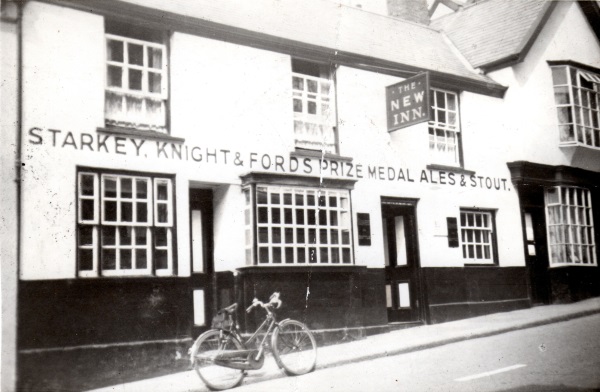
The
New Inn, Pilton Street, in the 1820's This is now a private house, but in the 1850s, and perhaps earlier, it was the home of Benjamin Manning and his family. . Benjamin must have been an enterprising and interesting local character, which is surely why the Manning name, and its association with the field known as Manning Pit, has lasted until the present time. Read more here about Benjamin Manning and his family Could Benjamin Manning have sold one of Lee's paintings at auction, and could the painting "Cover Side" which is in the Tate Gallery have been painted down in the bottom of Manning's Pit? The part that is known as the Pit is at the bottom of the field and wooded (note the animals were added by Sir Edwin Landseer) More research to do!. |
| The
Battle of Manning's Pit - video of John Norman reading
the poem, from the Pilton Story website |
The
Battle of Manning's Pit - text of Brian Norman's Poem |
 We know that Saki's mother was either injured or badly frightened by a runaway cow. One story is that this happened near Pilton Church. Could it have been one of the Manning cows, escaped from Manning's Pit? |
This is the house where the famous
short story writer Saki (H H Munro) lived as a boy. It
is possible that he would have walked down behind his
house to the river, and played alongside its banks as
far as Manning's Pit - only about a quarter of a mile
away. That is, if he could have escaped from his aunts,
who were apparently so frightened of cows that they
would not let the children roam free. We are
investigating this, and there will be more about Saki to
come here. In the meantime, do look him up on Google,
and read his short stories. One of the most famous is
Sredni Vashtar, and these words are close to the end of
the story:
"The great polecat-ferret made its way down to a small brook at the foot of the garden, drank for a moment, then crossed a little plank bridge and was lost to sight in the bushes. Such was the passing of Sredni Vashtar." Was he thinking of Manning's Pit bridge when he wrote those words? |
| Egg
pacing in Manning's Pit, in 1986 or 1987 Sledging in Manning's Pit - photos to come |
To come ...Walking out... how
many courting couples decided to marry while walking in
Manning's Pit? How many people can trace their
grandparents footsteps through the fields? See Ricky Knight's video on our video page, for his memories of walking in Manning's Pit with his future wife, and also of course the film "The Magic of Manning's Pit", where one of the local residents talks about the time her husband proposed to her.. |
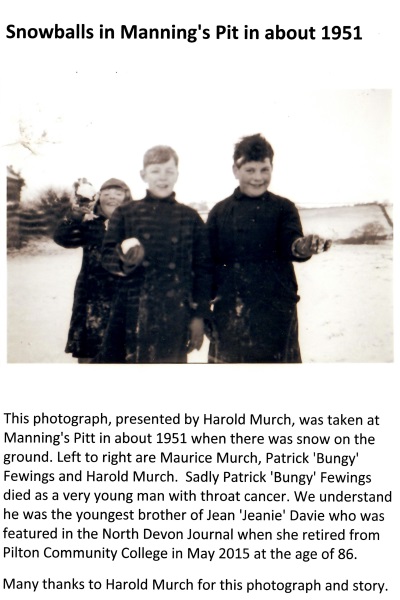 Snowballing in Manning's Pit, 1951 |
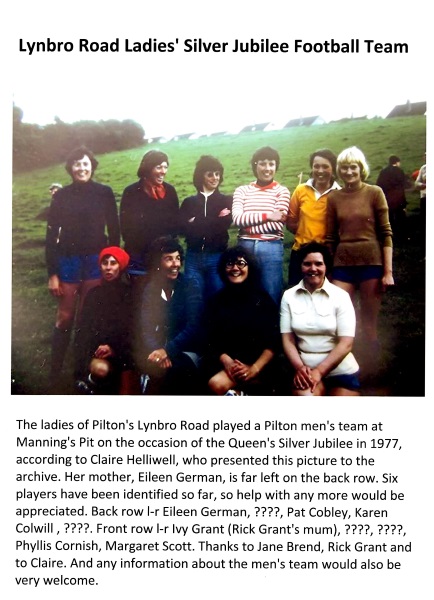 The famous men versus women football team, in Manning's Pit, 1977 |